


KATHMANDU, AUGUST 17
The country should improve coordination among the three tiers of government and strengthen the capacity of provincial and local governments to raise their own revenue, speakers said at a national policy dialogue in Lalitpur on Monday.
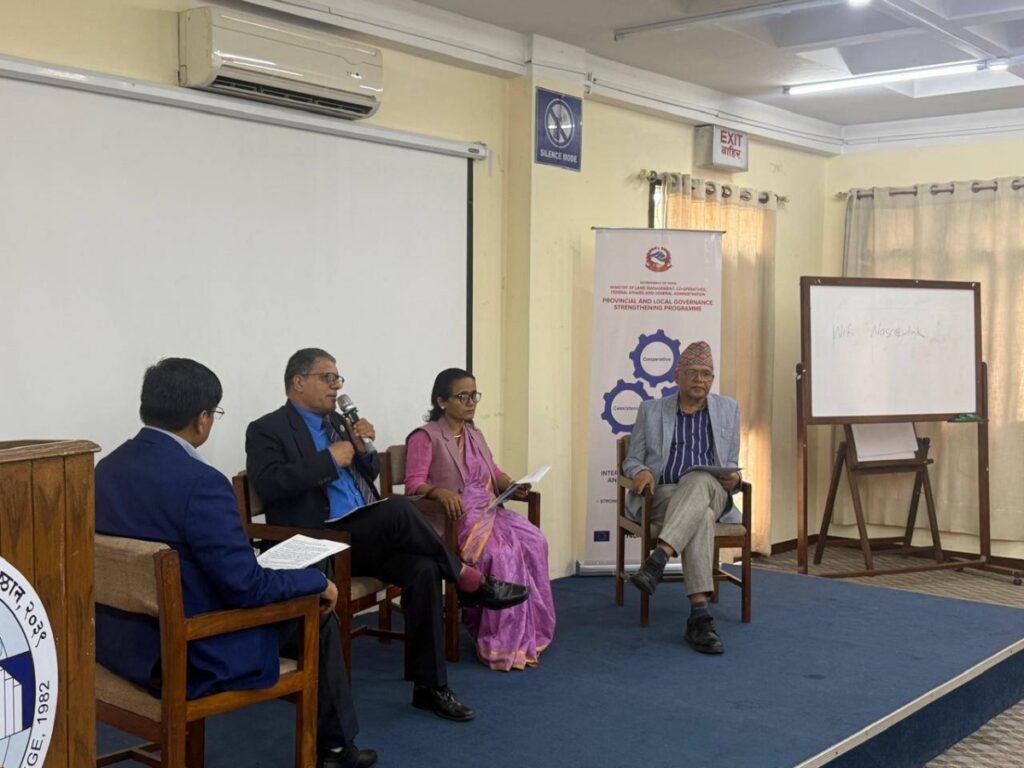
Such a call came at the Policy Dialogue on Intergovernmental Relations (IGR) and Own Source Revenue (OSR) organized by the Provincial and Local Governance Strengthening Programme (PLGSP) under the Ministry of Land Management, Cooperative, Federal Affairs and General Administration (MoLMCFAGA), at the Nepal Administrative Staff College. PLGSP is supported by the Government of Nepal, European Union, Government of Norway, Swiss Agency for Development and Cooperation, and the United Nations Development Programme (UNDP).
The dialogue brought together representatives of federal, provincial and local governments to discuss practical reforms in IGR and OSR, the two closely linked areas of the federal system, with a focus on making coordination more effective and strengthening fiscal autonomy at the subnational level.
Addressing the inaugural session, MoLMCFAGA Joint-Secretary Dilaram Panthi said, “The Government of Nepal, through Ministry of Land Management, Cooperative, Federal Affairs and General Administration, has been bringing all three levels of government onto a single platform for discussion.” He said such policy dialogues were intended to bring relevant stakeholders together to identify practical improvements in coordination, institutional arrangements and revenue systems.
UNDP Resident Representative Kyoko Yokosuka said the next phase of federalism should focus on making existing institutions work more effectively. “The first decade of federalism was about building the architecture. The next decade must be about making it work for people,” she said, adding that citizens would ultimately judge the success of federalism not by number of institutions that have been created, but by whether the governments are more responsive, services are better, and opportunities are more accessible.
Speaking on behalf of development partners, Deputy Head of Mission at the Embassy of Switzerland, Matthias Meier, said effective federalism depends not only on institutional structures but also on strong relationships among the three tiers of government. “Cooperation should be practical. It must be exercised regularly,” he said, stressing the importance of trust and solidarity in fiscal federalism.
A key part of the programme was a panel discussion titled “From Coordination to Delivery: Making Cooperative Federalism Work.” In the session, former Constituent Assembly member Khimlal Devkota, Tribhuvan University Professor Dr. Binod Pokharel, and Chair of National Association of Rural Municipalities in Nepal (NARMIN) Laxmi Pandey shed light on how intergovernmental arrangements can translate into more effective implementation and delivery.
A second panel, “Fiscal Policy Solutions Roundtable: What Next?”, focused on practical fiscal policy issues and the way forward. The session featured secretaries from Madhesh and Sudurpaschim Provinces Mahesh Baral and Rajendra Kumar Hamal and Krishna Pathak of the Asian Development Bank.
According to the policy analysis on “Cooperative Federalism in Action: Nepal’s Inter-Governmental Landscape” by PLGSP, while key coordination mechanisms have been established at federal, provincial and local levels, challenges continue, including fragmented planning and budgeting, weak follow-up on decisions, limited information sharing, overlapping responsibilities and uneven coordination across levels of government.
Similarly, an OSR assessment undertaken in 25 local governments by PLGSP has identified weak taxpayer registries, outdated valuation systems, limited digitalisation, fragmented revenue administration and institutional capacity constraints among barriers to stronger own-source revenue.
More than 65 participants, including representatives from the Office of the Prime Minister’s and Council of Ministers, Offices of the Chief Minister and Council of Ministers, Ministry of Finance, MoLMCFAGA, National Planning Commission, National Natural Resources and Fiscal Commission, Office of the Auditor General, local governments, Municipal Association of Nepal, NARMIN, Association of District Coordination Committees of Nepal, development partners, academia, and civil society attended the policy dialogue.